Products / Product lines / RangeStart

Trail Range product line

RangeStart

Early-Life Livestock Nutrition

Development platformCow-calf producers
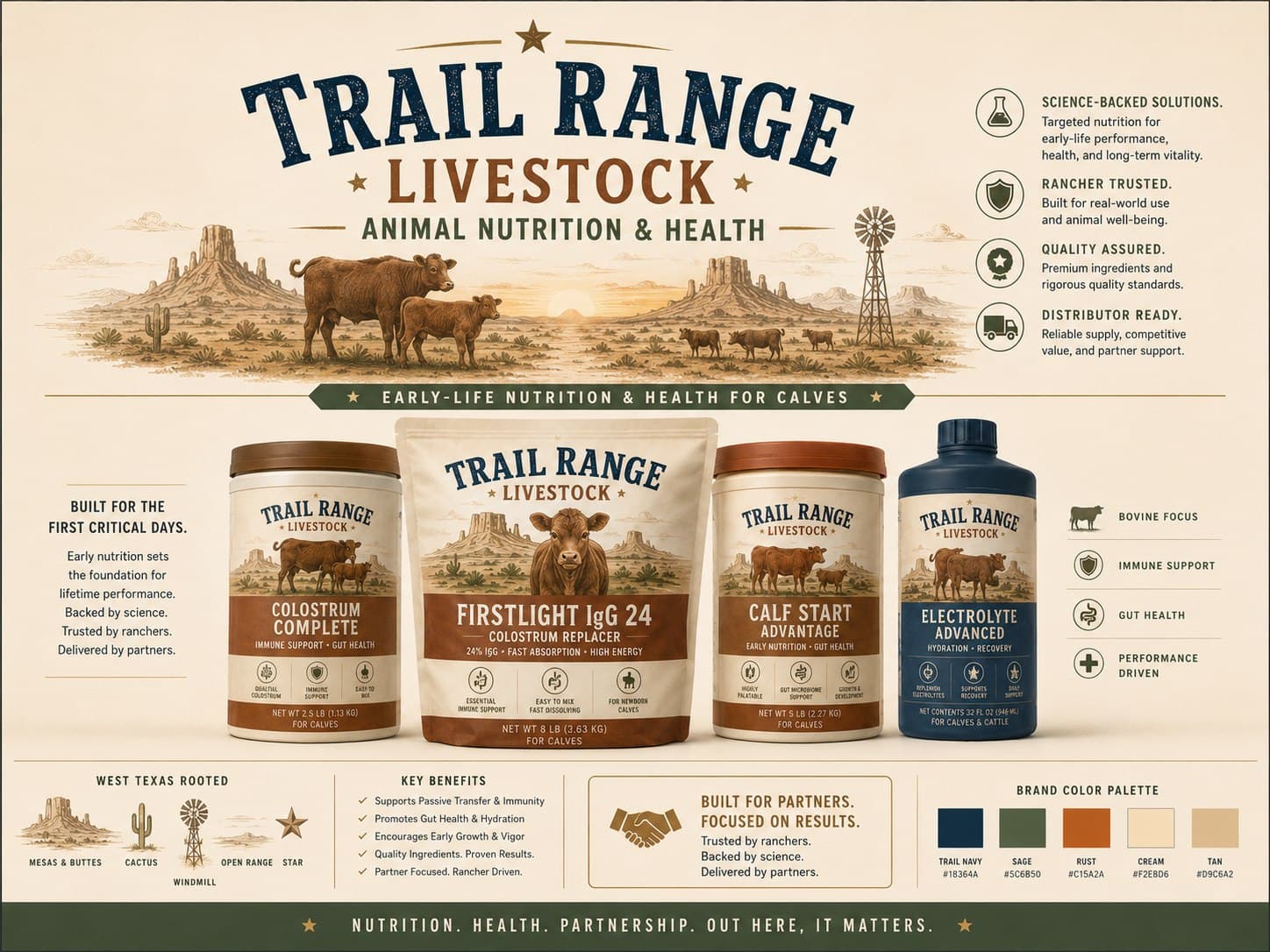
Early-life livestock development concept board featuring the FirstLight IgG 24 colostrum-replacer concept with colostrum, calf-start and electrolyte formats
Development concept board — names, claims and formats shown are not approved product facts.
Products
42 specified
Categories
6development targets
Evidence
11sources in the register

The Trail Range early-life livestock nutrition family, connecting neonatal support, transition nutrition and practical calf-development programs.

  • Colostrum programs
  • Neonatal nutrition
  • Hydration
  • Transition nutrition

Named finished products remain in development until formula, specification, label and commercial documentation are approved.

Market role

Early-Life Livestock Nutrition

RangeStart is the umbrella early-life nutrition family. FirstLight is the endorsed neonatal brand within it, led by the FirstLight IgG 24 bovine colostrum-replacer concept.

Cow-calf producersDairy operationsCalf raisersLivestock professionalsAgricultural distributors

Products in this line

4 concepts, 2 specified

Draft formulations and development targets. Every figure is a value the formula is built to, not a verified result — a guaranteed analysis comes from assay of finished production batches, and none has been made.

Development categories

What can be specified now, and what needs a trial.

Two different kinds of blocker, deliberately kept apart. Specification work is reachable today from public standards, calculation and analysis. A trial is not. Presenting them as the same thing reads as if nothing can proceed.

Colostrum programs

Establishing passive immunity in the first 24 hours, before gut closure ends the absorption window.

Evidence today
Programs are assessed against a four-tier serum IgG framework rather than a single pass/fail cutoff, with herd-level distribution goals. Program quality rests on colostral IgG concentration, cleanliness, timing and volume. On-farm Brix refractometry is a reasonable quality screen, though its accuracy degrades between cutoffs.
Specifiable now
Composition, verified: IgG mass per dose by analytical method, source and processing history, and lot-to-lot consistency. A written USDA CVB determination on the product description and draft claims costs nothing and converts the largest legal unknown into a document.
Requires a trial
Achieved passive transfer, which is an outcome in the calf determined by timing and management the product does not control. Marketing a product as treating failure of passive transfer requires a USDA veterinary biologic licence — composition may be stated; passive transfer may not be promised.

Neonatal nutrition

Nutrient supply to a functionally monogastric animal dependent on liquid feed while the rumen develops.

Evidence today
Requirements for preweaning cattle are specified at standards level. IgG source and absorption efficiency — not IgG mass alone — drive achieved serum IgG: measured absorption efficiency differed substantially between colostrum-derived and plasma-derived products.
Requires a trial
Product-specific validation. One marketed replacer achieved adequate passive transfer in a small minority of calves; performance is never inherited from the category.

Hydration

Water is the largest-volume nutrient in production and the first constraint under heat load.

Evidence today
Requirements rise sharply with temperature, and restriction reduces intake and performance. Electrolyte supplementation shifted hydration and acid-base markers in heat-stressed cattle but did not change bodyweight, condition, respiration rate or body temperature.
Requires a trial
Defined heat-stress-window endpoints. The evidence supports physiological effect, not production or thermotolerance benefit.

Transition nutrition

Two distinct windows often conflated — the move off colostrum, and weaning off liquid feed entirely.

Evidence today
The weaning transition is comparatively well studied: rumen fermentation, papillae development and rumination must be established before liquid withdrawal. Evidence for supplemental products in the immediate post-colostral days is weaker and mixed.
Requires a trial
Product-specific trial data. Physiology and requirement standards support the category; they do not substantiate a specific supplemental product.

Calf starters

Driving rumen development ahead of weaning, not merely supplying nutrients.

Evidence today
Fermentable carbohydrate consumption produces the volatile fatty acids that stimulate rumen epithelial development. Design is not simply maximising fermentability — high-starch, low-fibre starters may work against development, and physical form matters alongside composition.
Requires a trial
Claims should rest on nutrient delivery and physical form rather than asserted rumen-development outcomes.

Early-life monitoring

Giving producers a way to see whether a colostrum program is working, rather than assuming it is.

Evidence today
The measurement framework exists and is well defined: serum IgG or total protein at 24–48 hours, read against the four-tier framework and its herd-level distribution goals, with Brix refractometry as an on-farm colostral screen.
Specifiable now
The whole of it. Serum IgG or total protein at 24 to 48 hours, Brix refractometry cutoffs with the confidence attached to each, and a herd-level distribution target. This is protocol and tooling rather than product formulation.
Requires a trial
Nothing. Monitoring supports a program; it makes no claim about any product, so there is no product claim to substantiate.

Formulation direction

What the evidence supports — and what it does not.

Development inputs, not finished formulas. Each candidate is graded on the published evidence, including the ingredients the evidence tells us to leave out.

Colostrum programs and neonatal nutrition

Establishing passive immunity in the first 24 hours, when gut closure limits the absorption window.

Lead with

  • IgG source and absorption efficiency, not IgG mass alone

    Established

    The decisive formulation insight in this category. Apparent efficiency of absorption measured 38.8% for a colostrum-derived product against 21.6% for a plasma-derived one, producing very different passive-transfer rates from comparable IgG mass. Source selection outranks dose.

    Basis2013Controlled study2007Controlled study

  • Clinoptilolite in the first-24-hour colostrum window, at low inclusion

    Emerging

    One controlled trial (n=60) found higher serum IgG and higher apparent efficiency of absorption when a clinoptilolite suspension accompanied colostrum; a second (n=18) found γ-globulin — a proxy measure, not IgG directly — above control at 0.5%. Both point to enhancement rather than interference, and both come from closely related research groups, with the window set by gut closure. Critically dose-dependent: roughly 0.5% of the meal outperformed 2%, and higher intakes turn the effect the other way. Tolerance at up to 2% of milk replacer over 28 days is separately documented. Specify clinoptilolite by name and CAS number: chabazite, phillipsite and synthetic zeolite A are different materials with different behaviour and no transferable evidence.

    Basis2008Controlled study2018Controlled study2008Controlled study

  • Oral electrolyte formulation for rehydration

    Moderate

    Oral electrolyte solution outperformed intravenous and subcutaneous routes for restoring plasma volume and correcting blood pH in calves retaining gut function. Sodium content, alkalinising capacity, energy source and osmolality are the formulation variables.

    Basis2019Controlled study

Deprioritise or exclude

  • Inherited category performance data

    Counter-indicated

    Performance is product-specific. One marketed replacer achieved adequate passive transfer in 6.9% of calves against 72% on maternal colostrum. No product may borrow another's result, and the disease-risk epidemiology attached to failure of passive transfer is associational, not a measured product effect.

    Basis2016Systematic review2007Controlled study

Claim ceiling. Composition only until licensed. Marketing a product as treating failure of passive transfer requires a USDA veterinary biologic licence; immune and immunoglobulin claims fall under biologics licensing, not feed registration. A numeric designation may denote verified IgG per dose but must never imply achieved serum IgG.

Substantiation required. Product-specific passive-transfer verification against an untreated arm, analytical IgG method and lot consistency, and — for any replacer or immunity positioning — the licensing pathway rather than feed registration.

Evidence map

Sources connected to this line — with their limits visible.

These sources guide standards, ingredient review and study design. They do not automatically substantiate an unfinished product.

11 sources · 2026 back to 2007

2026 · Regulatory guidance

9 CFR Part 102 — licensing of veterinary biological products

USDA APHIS (Virus-Serum-Toxin Act, via eCFR)

Scope. Establishment and product licence requirements, and the data establishing purity, safety, potency and efficacy that an application must include.

Supports. Defines the pathway for any product presented as acting on immunity, and requires that all claims intended for labels and advertising be submitted as part of the application.

Does not establish. Does not apply to products marketed purely on nutrient contribution; conversely, no feed registration substitutes for a biologic licence where an immunity claim is made.

Primary source ↗

2020 · Consensus recommendations

Consensus recommendations on calf- and herd-level passive immunity in dairy calves in the United States

Journal of Dairy Science

Scope. Replaces the binary pass/fail passive-transfer standard with four serum IgG categories and corresponding herd-level distribution goals.

Supports. The current US reference framework against which a colostrum program and any product used within it should be benchmarked and monitored.

Does not establish. Does not establish that any product or protocol moves calves between categories; it defines measurement thresholds and herd targets, not interventions.

Primary source ↗

2019 · Controlled study

Comparison of oral, intravenous and subcutaneous fluid therapy for resuscitation of calves with diarrhea

Journal of Dairy Science

Scope. Randomised trial in calves with induced diarrhoea and dehydration comparing oral electrolyte solution against intravenous and subcutaneous routes.

Supports. Substantiates a properly formulated oral electrolyte as first-line rehydration for calves that retain a functional gut.

Does not establish. Does not reflect naturally occurring disease — diarrhoea was experimentally induced, acidemia was relatively mild, and treatment arms were not composition-matched.

Primary source ↗

2018 · Controlled study

Serum protein electrophoretic pattern in neonatal calves treated with clinoptilolite

Molecules

Scope. 18 calves in three groups — colostrum alone, colostrum plus 0.5% clinoptilolite, colostrum plus 2% — dosed within two hours of birth and again at 12 and 24 hours.

Supports. The only head-to-head dose comparison in the colostrum window: at 30 hours the 0.5% group showed γ-globulin markedly above control, and the authors conclude the lower dose was the more effective of the two.

Does not establish. Does not measure IgG directly (γ-globulin is a proxy), uses six calves per arm, records no clinical endpoint, and shows the higher 2% dose performing worse than 0.5% — the effect is dose-critical, not linear.

Primary source ↗

2016 · Systematic review

Failure of passive immune transfer in calves: a meta-analysis on the consequences and assessment of the economic impact

PLOS ONE

Scope. Meta-analysis of 68 published models quantifying adjusted risk of mortality, respiratory disease, diarrhoea and overall morbidity associated with failure of passive transfer.

Supports. Quantifies the health burden attached to failure of passive transfer, justifying it as a high-value development target.

Does not establish. Does not demonstrate that raising serum IgG by any given intervention delivers a proportional reduction in disease — the estimates are associational, with substantial heterogeneity.

Primary source ↗

2016 · Systematic review

Diagnostic accuracy of refractometry for assessing bovine colostrum quality: a systematic review and meta-analysis

Journal of Dairy Science

Scope. Meta-analysis of 11 studies and 4,251 colostrum samples evaluating Brix refractometry against an IgG standard at different cutoffs.

Supports. Validates on-farm Brix as a screening input for colostrum quality decisions and quantifies the confidence each cutoff carries.

Does not establish. Does not establish that Brix predicts a calf's achieved serum IgG — it measures agreement with colostral IgG concentration only.

Primary source ↗

2016 · Systematic review

Invited review: transitioning from milk to solid feed in dairy heifers

Journal of Dairy Science

Scope. Review of rumen ecosystem development, fermentation, papillae growth and rumination behaviour across the milk-to-solid-feed transition.

Supports. Informs starter formulation direction — specifically the balance between physically effective fibre and readily degradable carbohydrate.

Does not establish. Does not provide a validated numeric formulation specification, and as a narrative review applies no systematic risk-of-bias appraisal.

Primary source ↗

2013 · Controlled study

Effect of feeding maternal colostrum or plasma-derived or colostrum-derived colostrum replacer on passive transfer, health and performance of preweaning heifer calves

Journal of Dairy Science

Scope. Three-arm trial comparing maternal colostrum against plasma-derived and colostrum-derived replacers, measuring apparent efficiency of absorption and passive-transfer adequacy.

Supports. Establishes that IgG source and absorption efficiency — not IgG mass alone — drive achieved serum IgG, a core formulation consideration.

Does not establish. Does not establish an upper bound on replacer performance, as it tested a single dose of each replacer rather than dose-matched IgG.

Primary source ↗

2008 · Controlled study

Apparent efficiency of immunoglobulin absorption in newborn calves orally treated with zeolite

Acta Veterinaria

Scope. 60 Holstein calves in four groups, fed colostrum at two volumes with or without a 25% clinoptilolite suspension, measuring serum IgG and apparent efficiency of absorption.

Supports. The largest trial addressing clinoptilolite and colostral immunoglobulin directly: serum IgG at six hours was significantly higher with zeolite at the lower colostrum volume, and apparent efficiency of absorption was highest in that group — the mineral enhanced rather than impaired absorption.

Does not establish. Does not establish a mechanism, was not blinded, records no clinical outcomes such as morbidity or scours, and comes from a single research group.

Primary source ↗

2008 · Controlled study

Clinical observations, biochemical data and postmortem findings in young dairy calves fed zeolite clinoptilolite with milk replacer

American Journal of Veterinary Research

Scope. 26 Holstein calves fed milk replacer with 0%, 0.5% or 2% clinoptilolite twice daily for 28 days, all necropsied.

Supports. The best tolerance dataset in neonatal calves — no gross lesions attributable to treatment at necropsy, and no adverse haematology or biochemistry.

Does not establish. Does not show any benefit; it was designed as a safety study, found no difference in bodyweight or average daily gain, and reported an unexplained increase in jejunal mucosal eosinophils in treated calves.

Primary source ↗

2007 · Controlled study

Passive transfer of immunoglobulin G and preweaning health in Holstein calves fed a commercial colostrum replacer

Journal of Dairy Science

Scope. Trial comparing maternal colostrum against a commercial colostrum replacer regimen, measuring 24-hour serum IgG and passive-transfer adequacy.

Supports. Demonstrates directly that a marketed colostrum replacer can fail to deliver adequate passive transfer, establishing why product-specific validation is mandatory.

Does not establish. Does not generalise to all replacers — the result characterises one product and dosing regimen, not the category.

Primary source ↗