Crude Protein min.
- As fed
- 34%
- no limit written on this basis
- Dry matter
- 37.78%
- floor 18%
- Within — 19.78% to spare
- Per 1,000 kcal
- 82.13g
- floor 45g
- Within — 37.13g to spare
Products / Trail Range Canine / Active Working Dog
Trail Range Canine · Canine
The Trail Range Canine food, and the density is the point. Sustained work runs on fat oxidation, so this is built at a fat level no companion formula reaches — which also makes it the wrong food for a dog that is walked rather than worked.
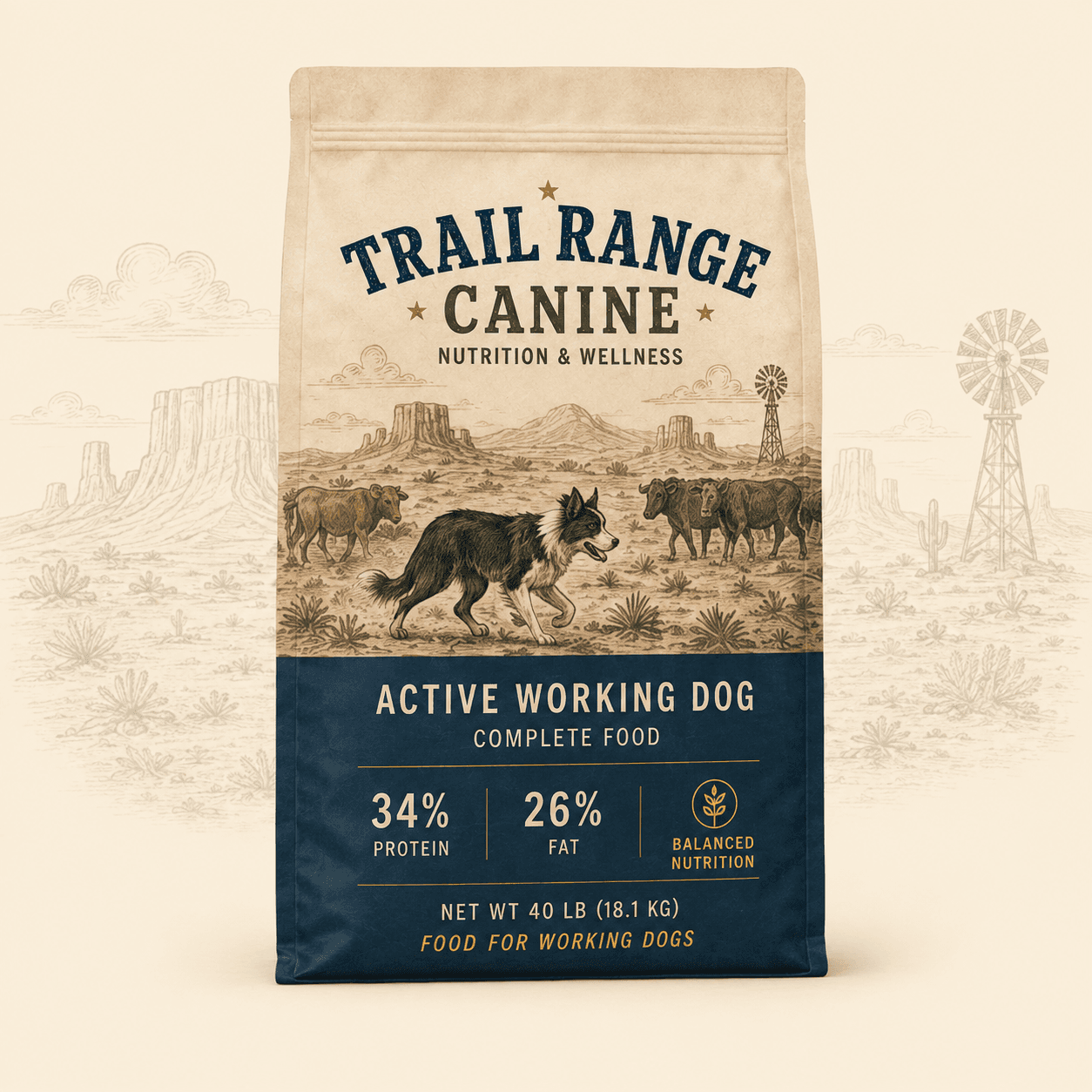
Statements of fact about the formula. None is a health claim.
Online ordering opens once distribution is in place. Wholesale and trade inquiries are open now.
Checked on the basis that governs
A percentage that is correct on the bag can still fail the basis a regulator reads. The AAFCO ceilings are written on a dry-matter basis, so the moisture maximum decides whether an as-fed figure clears them — and an energy-dense food can bind on the per-1,000-kcal basis first. Every figure below is computed from the formulation rather than written alongside it.
As fed carries no verdict because AAFCO writes no limit on that basis. Reporting a pass there would invent a standard rather than apply one.
Guarantee against formulation
A guarantee is a floor, not a target. The distance between the two is the margin a production run can move within before the label stops being true, and a control fails the build if any formulation ever sits below its own guarantee.
Crude Protein
+2.6 pts34.0% guaranteed · 36.6% delivered
Crude Fat
+2.2 pts26.0% guaranteed · 28.2% delivered
The detail
Development targets from the working formulation. A guaranteed analysis is derived from assay of finished production batches, and none has been made — so these are the values the formula is built to, not results.
| Crude Protein | min. | 34.0% |
|---|---|---|
| Crude Fat | min. | 26.0% |
| Crude Ash | max. | 11.0% |
| Crude Fiber | max. | 4.0% |
| Moisture | max. | 10.0% |
| Omega-3 Fatty Acids* | min. | 1.1% |
| EPA + DHA* | min. | 0.40% |
Not recognised as essential nutrients by the AAFCO Dog Food Nutrient Profiles.
1 cup (115 g) · approx. 476 kcal — density to be confirmed on production runs
4,140 kcal/kg calculated metabolisable energy · approx. 476 kcal per cup at 115 g
Calculated by the modified Atwater method. Measured values typically run 5–9% higher on dry food, so this is restated once batch data exists.
Formulated to meet the nutritional levels established by the AAFCO Dog Food Nutrient Profiles for maintenance.
How these are derived. Resting energy requirement is 70 × bodyweight in kilograms^0.75, multiplied by the factor for the life stage and divided by 476 kcal per cup. Every figure below is that calculation on this product’s own energy density — not a table copied from another food. Feed to maintain ideal body condition; an individual dog can sit 20% either side of these.
By the dog’s adult weight, once fully grown.
| Adult weight | Neutered1.6 × RER | Intact or active1.8 × RER |
|---|---|---|
| 10 lb (4.5 kg) | 0.7 cups | 0.8 cups |
| 20 lb (9.1 kg) | 1.2 cups | 1.4 cups |
| 30 lb (13.6 kg) | 1.7 cups | 1.9 cups |
| 40 lb (18.1 kg) | 2.1 cups | 2.3 cups |
| 50 lb (22.7 kg) | 2.4 cups | 2.8 cups |
| 60 lb (27.2 kg) | 2.8 cups | 3.2 cups |
| 80 lb (36.3 kg) | 3.5 cups | 3.9 cups |
| 100 lb (45.4 kg) | 4.1 cups | 4.6 cups |
Feed twice daily using a standard 8 oz measuring cup, adjusting to maintain ideal body condition. Introduce gradually, mixing with the current food. Fresh drinking water at all times.
No gestation or lactation table is published here. This label’s adequacy statement names growth rather than reproduction, and a feeding table for a life stage the statement does not cover would claim more than the label does.
Chicken meal, poultry fat (preserved with mixed tocopherols), deboned chicken, dried egg product, brown rice, fish oil, dried beet pulp, chicken digest, flaxseed, dicalcium phosphate, potassium chloride, salt, choline chloride, zinc proteinate, iron proteinate, vitamin E supplement, taurine, L-carnitine, manganese proteinate, copper proteinate, niacin supplement, calcium pantothenate, thiamine mononitrate, riboflavin supplement, pyridoxine hydrochloride, vitamin A supplement, biotin, folic acid, sodium selenite, calcium iodate, vitamin D3 supplement, vitamin B12 supplement, mixed tocopherols and rosemary extract (preservatives).
Descending order by weight, using AAFCO ingredient names. Not truncated behind a “read more” — the list is the product.
These describe formulation decisions. They are not health claims, and no effect on any condition is asserted or implied.
The panel itself
The artwork that goes on the pack, beside the guarantee it carries.
Active Working Dog
Label panel pending
A buyer comparing two bags is reading label panels. Showing ours at full size, beside the same figures in the table above, is a claim that cannot be made cheaply: it requires the artwork and the specification to already agree.
Where the artwork does not exist yet the band still builds, with a marked placeholder holding the space — so the page keeps one shape across the range and a missing panel reads as pending rather than as a design that broke.
Concept board
The artwork program supplies one presentation board per product. Where a board is not yet available for publication, the pack render or a marked placeholder holds the slot.
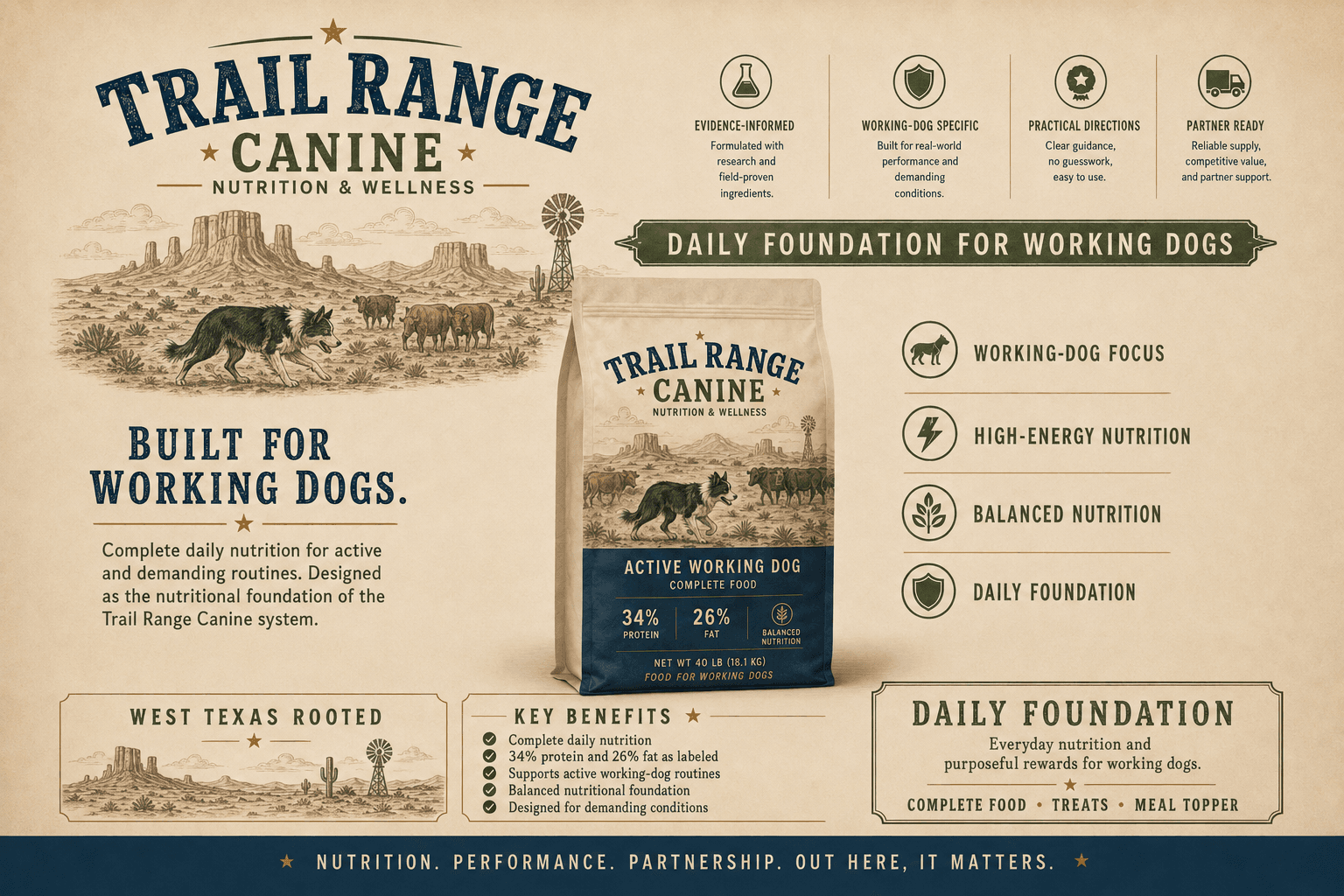
Concept artwork only. Product facts, claims, sizes, specifications and availability are not inferred from the images.
Market role
Trail Range Canine serves professional and working-dog channels. Trail Mutts remains the warmer consumer-facing canine lifestyle and dogcare brand.
Line-level context, shown here because it answers “what is this for” at the moment someone is looking at one product. The line page carries it in full.
Formulation direction
Development inputs, not finished formulas. Each candidate is graded on the published evidence, including the ingredients the evidence tells us to leave out.
Sustained comfortable movement in dogs at risk of, or living with, degenerative joint change.
Lead with
Energy control and body-condition management
EstablishedThe best-evidenced nutritional lever on joint outcomes by a wide margin. Lifetime 25% food restriction pushed median first radiographic hip osteoarthritis from 6 years to 12. In obese dogs, lameness change became detectable from roughly 6% bodyweight loss subjectively and 9% on gait analysis. This is a formulation and feeding-guidance decision, not an additive.
Long-chain omega-3 fatty acids (EPA/DHA)
ModerateThe highest-ranked functional ingredient in a 72-trial meta-analysis, and the only nutraceutical a 2012 systematic review found adequately supported in dogs. Whole-diet enrichment raised serum omega-3 and moved owner-assessed function over six months across 18 practices.
Green-lipped mussel lipid extract
ModerateProduced measurable change in force-plate peak vertical force in a blinded, placebo-controlled trial — objective gait data rather than owner impression.
Basis2023Controlled study
Deprioritize or exclude
Glucosamine and chondroitin sulfate
Counter-indicatedIn the same blinded trial that showed marine lipids moving peak vertical force, glucosamine/chondroitin performed similarly to placebo, and the 2022 meta-analysis reported a marked non-effect. Category convention, not evidence, keeps this pairing in products.
Claim ceiling. Nutrient contribution and normal structure-function only. Joint or mobility improvement claims name a body system beyond nutritive value and read as drug claims.
Substantiation required. A controlled trial on the finished formula in the target population using validated outcome measures, plus analytical verification and stability data for the active fraction.
Nutrient and protein digestibility, fecal consistency and volume, and hindgut fermentation.
Lead with
Fiber matrix — beet pulp and mixed fermentable/insoluble sources
ModerateThe strongest evidence in this category sits with fiber rather than microbial ingredients. Beet pulp raised dry matter and total dietary fiber digestibility and lowered wet fecal output versus cellulose and Miscanthus, with a documented trade-off against crude protein digestibility that formulation must balance.
Protein quality and digestibility
EstablishedConsensus veterinary guidance treats diet as the first-line intervention in chronic enteropathy, with hydrolyzed and fiber-enriched formulations showing the highest response rates. Formulate on protein quality rather than crude protein alone.
Deprioritize or exclude
Probiotics as a headline ingredient
EmergingA systematic review of 17 canine trials found a very limited and possibly clinically unimportant effect with moderate-to-high risk of bias, and consensus panels give probiotics only a weak recommendation. Effects are strain- and dose-specific and cannot be extrapolated between strains, so a named deposited strain with its own data is the minimum bar.
Clinoptilolite for canine digestive support
InsufficientGenuinely promising in neonatal calves, but the canine evidence is close to absent — one unblinded ten-dog study in a non-indexed journal. The one controlled canine microbiota trial used a different zeolite with clinoptilolite absent, and the most rigorous trial against a diarrhea endpoint in any species missed its primary endpoint.
Claim ceiling. Nutritive value only. Digestive-health and stool claims name a body system and require pre-market review.
Substantiation required. Controlled canine data on the specific finished formulation, verified viable counts at end of shelf life for any named strain, and defined inclusion levels.
Substrate supply for keratinization, hair growth and epidermal integrity.
Lead with
Linoleic acid, zinc and protein adequacy
EstablishedRequirements are settled at standards level, and deficiency of any of the three is associated with a dull, scaly or unkempt coat. Adequacy is the foundation; everything else is incremental.
EPA/DHA
ModerateA systematic review with formal risk-of-bias assessment identified benefit in canine haircoat disorder and allergic dermatitis, though in diseased animals under veterinary management rather than healthy-dog maintenance.
Deprioritize or exclude
Barrier-function positioning
InsufficientA 16-week randomized trial in healthy dogs found graded coat improvement from baseline but no difference between oils and no measurable change in transepidermal water loss — which specifically argues against a skin-barrier claim.
Basis2023Controlled study
Allergy or sensitivity positioning
Counter-indicatedDiagnosis of adverse food reaction requires a veterinarian-supervised elimination trial with controlled rechallenge; serological, salivary and hair testing are not reliable. A product named for seasonal or environmental support must never read as an allergy treatment. Ingredient verification testing matters here regardless: a median 45% of commercial foods tested contained unlisted ingredients.
Claim ceiling. Nutrient contribution to normal skin and coat. No allergy, dermatitis or barrier-repair language.
Substantiation required. Formulation records against published requirements, analytical ingredient verification, and a controlled coat-scoring study on the finished product.
Work capacity, thermal tolerance and inter-session recovery in dogs performing repeated physical work.
Lead with
Energy density and fat level matched to work type
EstablishedEnergy demand dominates and is context-dependent — measured requirements in racing endurance dogs ranged from roughly 9,000 to an extrapolated 13,800 kcal/day between race legs, driven by load, terrain and temperature rather than distance. Higher fat suits endurance work; balanced macronutrients suit sprint work.
Palatable oral electrolyte for voluntary intake
ModerateA flavored electrolyte solution more than doubled voluntary fluid intake versus plain water in working detection dogs in a hot environment, making palatability-driven intake a legitimate design objective in its own right.
Basis2017Controlled study
Deprioritize or exclude
Performance or thermoregulatory claims from hydration
InsufficientThe same trial that doubled voluntary intake detected no effect on core body temperature or olfactory search performance. Intake is the demonstrated outcome; performance is not.
Basis2017Controlled study
Claim ceiling. Nutrient and energy contribution. No performance, endurance or recovery outcome claims.
Substantiation required. Energy density and digestibility data, a controlled feeding trial in the intended working population with objective work and recovery endpoints, and field voluntary-intake data.
Every brief covering Trail Range Canine is shown rather than only those bearing on this product, because a brief is a development input for a category and not a statement about one item. Narrowing it further needs a per-product category on the record.
Evidence map
These sources guide standards, ingredient review and study design. They do not automatically substantiate an unfinished product.
10 sources · 2025 back to 2006
Association of American Feed Control Officials
Scope. Required label elements, the standardized nutritional adequacy statement formats, and what constitutes misbranding.
Supports. Gives the exact prescribed wording for each substantiation route and confirms that an incorrect adequacy statement, or a disease claim without an approved drug, is misbranding.
Does not establish. Does not carry force of law on its own — AAFCO models bind only where a state has adopted them, and AAFCO approves, certifies and endorses nothing.
Primary source ↗Frontiers in Veterinary Science
Scope. Six-week block-randomized, double-blinded, placebo-controlled trial in 75 owned dogs measured against force-plate peak vertical force.
Supports. Objective gait evidence that marine lipid extracts can shift weight-bearing, and that glucosamine/chondroitin at 30 mg/kg/day performed similarly to placebo.
Does not establish. Does not extend beyond six weeks, found no significant between-group difference on subjective scoring, and was supported by a supplement manufacturer.
Primary source ↗Université de Montréal / International Journal of Molecular Sciences
Scope. Screened 1,578 publications and pooled 72 trials across nine categories of natural health compound in dogs and cats with osteoarthritis.
Supports. Ranks long-chain omega-3 fatty acids as the lead functional ingredient by effect size, and de-prioritizes glucosamine–chondroitin.
Does not establish. Does not validate any commercial formulation; the authors flag subjective outcome tools, groups often under ten animals, and wide variation in dose and duration.
Primary source ↗In Vivo
Scope. Systematic review of randomized controlled EPA/DHA studies in dogs and cats with Cochrane RoB2 risk-of-bias assessment; 23 studies included.
Supports. Identifies benefit in canine allergic dermatitis and haircoat disorder among included trials — the strongest single citation for an EPA/DHA coat rationale.
Does not establish. Does not establish effect size, dose or duration for a healthy-dog maintenance product; benefit was found in diseased animals under veterinary management.
Primary source ↗Journal of Veterinary Internal Medicine
Scope. Screened 165 studies, including 17 in vivo canine trials, grading design quality and risk of bias; stool consistency was the most reported outcome.
Supports. Establishes stool consistency as the practical primary outcome for canine digestive research and the need for strain-level data.
Does not establish. Does not support a general probiotic efficacy claim in dogs — the authors found a very limited and possibly clinically unimportant effect, with moderate-to-high risk of bias throughout.
Primary source ↗Journal of Animal Science / Kansas State University
Scope. Replicated Latin square in 12 Beagles comparing three fiber sources at 10% inclusion with total fecal collection.
Supports. Quantifies the fiber trade-off directly: beet pulp raised dry matter and total dietary fiber digestibility and lowered wet fecal output versus cellulose and Miscanthus.
Does not establish. Does not demonstrate a clinical gut-health benefit; beet pulp also lowered crude protein digestibility and produced softer stools, in 12 healthy laboratory dogs at one inclusion level.
Primary source ↗Frontiers in Veterinary Science
Scope. Randomized cross-over field study in seven working dogs comparing plain water, flavored oral electrolyte solution and subcutaneous fluids.
Supports. Shows flavored electrolyte solution more than doubled voluntary fluid intake versus water, making palatability-driven intake a legitimate design objective.
Does not establish. Does not demonstrate any performance or thermoregulatory benefit — no effect was detected on body temperature or search performance.
Primary source ↗Veterinary Clinics of North America: Small Animal Practice
Scope. Review of nutritional physiology across canine work types, covering dietary fat, glycogen repletion, protein and aging working dogs.
Supports. The macronutrient design logic for work-type-specific formulation — higher fat for endurance, balanced macronutrients for sprint work, post-exercise carbohydrate for repeated efforts.
Does not establish. Does not rest on trial evidence for all work types; the authors state that studies for agility, field-trial and detection dogs are rare, so those recommendations are extrapolated.
Primary source ↗National Research Council / National Academies Press
Scope. Consensus requirements, adequate intakes and recommended allowances for every essential nutrient in dogs and cats, across life stages.
Supports. The quantitative floor and ceiling for formulating canine diets and complementary products.
Does not establish. Does not establish requirements, doses or efficacy for probiotics, prebiotics, postbiotics, glucosamine, collagen or any other non-essential ingredient.
Primary source ↗Journal of the American Veterinary Medical Association
Scope. Lifetime paired-littermate study in 48 Labrador Retrievers fed either ad libitum or 25% less of the same diet from eight weeks of age.
Supports. Establishes lifetime energy control as the best-evidenced nutritional lever on joint outcomes — median age at first radiographic osteoarthritis 12 years restricted versus 6 years control.
Does not establish. Does not test any supplement or functional ingredient, uses radiographic rather than pain endpoints, and studied one breed in a controlled colony.
Primary source ↗Rest of the line
Documentation
Three documents, and the state each is actually in. A buyer asking “what can you send me?” wants the answer as a list of things they can request, not as a status band they have to interpret.
Available now
Formulation, guarantees, the acceptance windows each is judged against and the regulatory edition in force, with a revision hash so two copies can be told apart.
Available now
Every claim the label makes, the basis for each one, and — the part buyers rarely get — the terms we have deliberately not used, with the reason.
On manufacture
Per lot, assayed against the acceptance windows above. Available once a production run exists — which is also when the guaranteed analysis stops being a target and becomes a result.
Formulation, guaranteed analysis, ingredient statement and label copy are documented, and the figures are checked against each other automatically rather than by proofreading.
Claim ceiling: Composition, energy density and feeding rate only. The feeding rate is a calculation from resting energy requirement and this product's own caloric density — arithmetic about the food, not a prediction about a dog, and two dogs doing identical work will not return identical results. Performance, endurance, recovery and stamina may not be claimed: they are structure/function claims under 21 U.S.C. § 321(g)(1)(C) however accurately they describe the animal's job, and a product sold for working dogs does not get more latitude than one sold for pets. It gets less, because the buyer is relying on it.


